Tree problems in Northeast Ohio can show up fast — spotted leaves in spring, thinning canopies in summer, strange bark damage in winter, or branches that suddenly start dying back. Some issues are mostly cosmetic, while others can kill a tree before homeowners realize how serious they are.
Diseases, like beech leaf disease, and common insect infestations have become a growing problem across the region, especially for mature trees already stressed by weather, soil conditions, or construction damage. The challenge usually isn’t noticing that something looks wrong. It’s figuring out whether the tree can recover, needs treatment, or has become a safety risk.
Key Takeaways
- Most tree problems in Northeast Ohio fall into one of four categories: leaf-level issues, branch and bark damage, whole-tree decline, or pest infestations — and the location of the symptom usually points to the cause.
- Some problems that look alarming — like maple tar spot — are cosmetic and won’t kill your tree, while others that look subtle — like beech leaf disease or oak wilt — can be fatal within a single season.
- Treatment timing matters more than treatment type; most tree treatments only work within a narrow window each year, which is why arborists track Growing Degree Days (a measure of accumulated warmth that predicts pest and disease activity) instead of calendar dates.
- A few simple practices — not pruning oaks in summer, not pruning elms in the growing season, not moving firewood between properties, etc. — prevent some of the most destructive tree problems in the region.
- The cheapest moment to address most tree problems is before symptoms become severe, which is also the moment most homeowners aren’t looking.
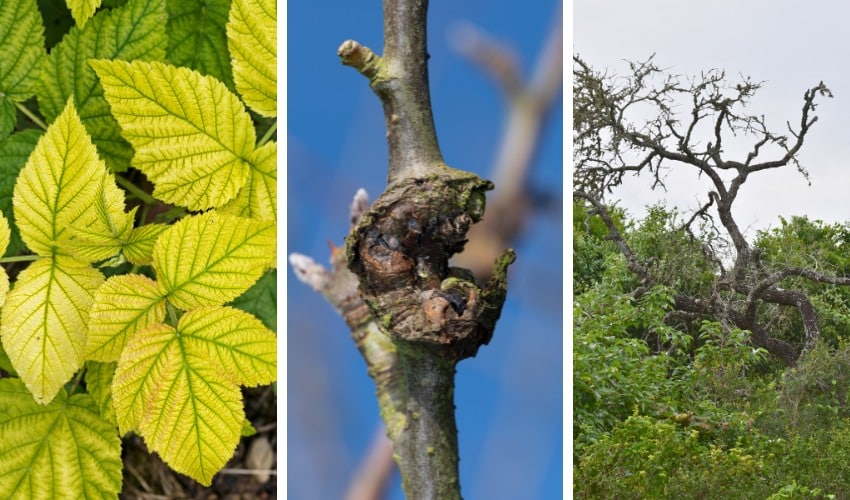
The three most common Northeast Ohio tree problems: leaf yellowing between green veins indicates chlorosis (left), bulging woody growths on branches indicate cankers (center), and a fully dead oak (right) — the eventual outcome of oak wilt, severe vascular disease, or other untreated decline.
How Do You Identify Tree Problems in Northeast Ohio?
The fastest way to identify a tree problem is to start with what you can actually see — the symptom, not the suspected cause. And you don’t need to be an arborist to make useful observations, you just need to know where to look. Most tree problems show up in one of four observation categories:
- Leaves: Spots, holes, yellowing, banding, wilting, or odd coloration.
- Bark and Branches: Cankers, oozing, dieback, exit holes, or unusual growths.
- Whole-Tree Appearance: Sudden flagging, top-down decline, lean, or thinning canopy.
- Pests Visible on the Tree: Webbing, sticky residue, eggs, or insects you can clearly see.
What Tree Problems Are Cosmetic, Treatable, or Dangerous?
Not every tree problem is an emergency, and worrying over the wrong one is one of the most common mistakes we see. Tree problems in Northeast Ohio fall into three urgency tiers:
- Cosmetic: These look dramatic but don’t threaten the tree’s life and treatment is usually optional; includes things like tar spot, mild leaf spot, powdery mildew, etc.
- Manageable: These need attention, but they’re not emergencies. Treatment timing is what determines success. This includes apple scab, anthracnose, fire blight, aphids, etc.
- Urgent: These move fast and are often fatal without intervention. Urgent problems include oak wilt, emerald ash borer, beech leaf disease, Dutch elm disease, hemlock woolly adelgid, etc.
Your concern level should match the urgency tier, not the appearance. We see homeowners who panic over dramatic-looking tar spot while ignoring early oak wilt symptoms that are quieter but far more serious. That’s because cosmetic problems usually live on the leaf surface, where they’re impossible to miss, while the most dangerous diseases work inside the tree — in the vascular tissue or root system — and only show subtle signs until significant damage is done. That’s why it’s so important to stay on top of regular tree maintenance and arborist inspections.
If you’re not sure which tier you’re looking at, our arborists can help you diagnose your tree’s pest or disease problem and recommend the next steps.
How to Tell What’s Wrong with a Tree
Most tree pests and diseases show visible symptoms long before a tree dies. The location, timing, and pattern of those symptoms help determine whether you’re dealing with a minor stress issue, an insect infestation, or a serious disease.
Leaf Symptoms
Leaf damage is one of the most common early warning signs. Discoloration, spotting, curling, wilting, or premature leaf drop can all point to different underlying problems depending on how and when they appear.
| Symptom | Likely Cause | Urgency | What to Do |
|---|---|---|---|
| Yellowing between veins, with veins staying green | Chlorosis — iron or manganese deficiency, usually from high soil pH | Manageable | Soil test; treatable through soil amendment or trunk injection |
| Yellowing of older leaves first; newer leaves stay green | Nitrogen deficiency or root issue restricting uptake | Manageable | Soil test before treating — over-fertilizing without knowing the cause can worsen root problems |
| Round black or brown spots on leaves | Tar spot on maples, apple scab on apples and crabapples, or one of several other leaf spot diseases | Cosmetic to manageable | Mostly cosmetic on established trees; rake and discard fallen leaves to break the cycle |
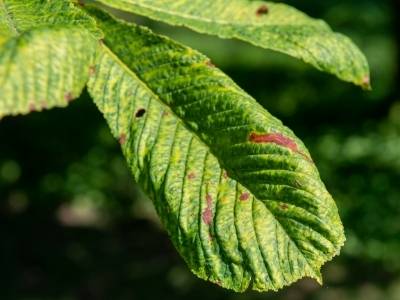
| Dark banding between leaf veins on beech | Beech leaf disease | Urgent | Get a professional diagnosis ASAP — early treatment matters |
| Powdery white coating on leaf surfaces | Powdery mildew | Cosmetic | Improve air circulation; rarely warrants treatment on healthy trees |
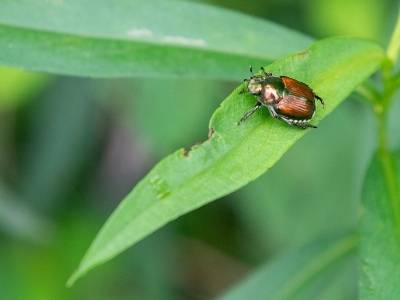
| Skeletonized “lace” appearance starting in late June | Japanese beetles | Manageable | Hand-picking or targeted treatment during peak adult activity |
| Tiny pale stippling, especially in hot, dry weather | Spider mites | Manageable | Increase tree vigor with proper watering; treat with horticultural oil if severe |
Bark and Branch Symptoms
Symptoms on the bark and branches are usually more serious than leaf symptoms. They often point to insects boring into the wood, bacterial infections, or vascular diseases — and the urgency level for these is typically higher than what you’d see on leaves alone.
| Symptom | Likely Cause | Urgency | What to Do |
|---|---|---|---|
| D-shaped exit holes in ash bark | Emerald ash borer (EAB) | Urgent | Call an arborist promptly — treatment timing decides whether the tree can be saved |
| Cankers oozing bacterial slime | Fire blight | Urgent | Call an arborist promptly — improper pruning spreads the bacteria further |
| Branches with a “shepherd’s crook” bend at the tip | Fire blight (apple/pear family) or white pine weevil (pines) | Manageable to urgent | Identify the species first; both require pruning out infected wood |
| Sudden branch dieback or flagging on oaks | Possible oak wilt | Urgent | Call an arborist promptly — and do not prune oaks between April and October |
| Bumps or growths on stems and branches | Usually galls on trees and plants | Cosmetic | Typically harmless; no action needed unless damage is severe |
| Sticky residue on leaves and surfaces below | Aphids or other sap-feeders | Manageable | Strong water spray, beneficial insects, or targeted treatment if widespread |
Whole-Tree Symptoms
When the symptom involves the whole tree rather than a leaf or branch, you’re usually dealing with something serious. These patterns warrant a professional diagnosis — guessing at the cause without examining the roots, soil, and full canopy together usually leads to the wrong treatment.
| Symptom | Likely Cause | Urgency | What to Do |
|---|---|---|---|
| Top-down canopy decline | Vascular disease (Dutch elm, EAB), drought stress, or root damage | Urgent | Call an arborist promptly — root and vascular issues require professional diagnosis |
| Conifer needles changing color and dropping | Could be normal seasonal needle drop, a spruce-specific pest or disease, or one of several other conifer issues | Varies | Identify the species and pattern first; some needle drop is seasonal and normal |
| General thinning canopy across the whole tree | Drought stress, root damage, or chronic pest pressure | Manageable to urgent | Check watering and root zone first; if no clear cause, get a professional assessment |
What Are the Most Common Tree Diseases in Northeast Ohio?
The most common tree diseases in Northeast Ohio are maple tar spot, fire blight, and apple scab. Beech leaf disease is just as widespread but moves fast enough to be considered among the most destructive threats in Northeast Ohio.
Maple Tar Spot
Maple tar spot is a dramatic-looking disease that almost never warrants treatment. It’s caused by a Rhytisma fungus and shows up most often in mature-canopy neighborhoods like Shaker Heights, Gates Mills, and Chagrin Falls — wherever maple cover is dense and fallen leaves accumulate. Despite the alarming appearance, it won’t kill the tree, won’t spread to other species in your yard, and doesn’t affect long-term tree health.
- What Works: Community-wide fall leaf cleanup is the most effective control; fungicide is rarely warranted on established trees.
- Look-Alikes Worth Ruling Out: Anthracnose, Phyllosticta leaf spot, and powdery mildew can all look similar at first glance.
Though they appear similar, anthracnose is more serious than tar spot and can cause twig dieback. If you’re seeing leaf spots paired with branch tip dieback, get a second opinion from an arborist. Beyond that distinction, maple tar spot management comes down to fall sanitation and patience.
Fire Blight
Fire blight is a bacterial disease that thrives in warm, humid spring weather and can devastate apple, crabapple, pear, hawthorn, and mountain ash trees in a single season. It’s caused by Erwinia amylovora, a bacterium spread by pollinators, rain splash, and contaminated pruning tools.
- Critical Practice: Sterilize pruning tools between every cut on a fire-blight-affected tree, or you’ll spread the infection yourself.
- No Cure, Only Management: Pruning out infected wood is the only real management option once a tree is infected.
Resistant varieties exist for most susceptible species and selecting them at planting time is the single best long-term defense.
Apple Scab
Apple scab is biologically similar to maple tar spot — same overwintering cycle, same sanitation playbook, fungal borne (Venturia inaequalis in this case) — but with one critical difference: it actually damages the tree. Affecting apple and crabapple trees throughout Northeast Ohio, scab causes cracked or deformed fruit and premature leaf drop in mid-summer, weakening the tree over multiple seasons.
- Treatment Timing: Fungicide applications start at bud break (typically late April in Northeast Ohio); they won’t help on already-infected leaves.
- Long-Term Solution: Plant scab-resistant cultivars when adding new crabapples to your landscape.
Unlike tar spot, the cycle is harder to break for apple scab because both leaves and fruit have to be cleaned up each fall. Skipping fallen fruit reinfects the tree the following spring just as effectively as skipping leaves.
What Are the Most Destructive Tree Pests and Diseases in Northeast Ohio?
The most destructive tree pests and diseases in Northeast Ohio are emerald ash borer, oak wilt, beech leaf disease, hemlock woolly adelgid, and Dutch elm disease. Some kill within a single season; others take a few years. All of them are mostly treatable when caught early.
Emerald Ash Borer (EAB)
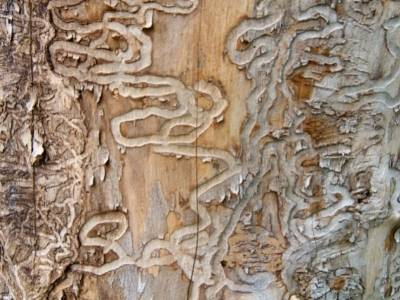
Emerald ash borer is an invasive wood-boring beetle whose larvae tunnel beneath ash bark, girdling the trunk and cutting off water and nutrient flow. EAB has spread throughout all of Ohio, and untreated ash trees rarely survive more than several years after infestation. Unusual woodpecker activity is often the earliest visible sign — appearing before the D-shaped exit holes are easy to spot.
Once an ash tree starts declining from EAB, the situation tends to become urgent quickly. These are the most important things homeowners should understand before deciding what to do next:
- Treatment: Trunk injection has proven effective when applied before significant decline.
- Treatment Window: May to mid-June for best results.
- Decision Point: Treat or remove — there’s no middle ground for declining ash.
If your ash trees are still healthy, treatment now is almost always cheaper than removal later. EAB has been confirmed in all 88 Ohio counties, but fortunately, several proven EAB treatment options exist for healthy ash.
Oak Wilt
Oak wilt is a vascular-wilt fungal disease (caused by Bretziella fagacearum) that kills oaks by clogging the tree’s water-conducting vessels — which is why a tree can wilt and die without any visible damage to the trunk. The disease affects all oaks, but red oak species (red, pin, scarlet, black) often die within weeks of the first symptoms, while white oak species (white, bur, swamp white) decline more slowly and sometimes survive.
The disease spreads two ways: sap-feeding beetles carry the fungus from infected to healthy trees from April through July, and root grafts between neighboring oaks transmit it directly underground. The biggest mistakes homeowners make with oak wilt usually involve pruning timing and waiting too long to act:
- Critical Homeowner Rule: Don’t prune oaks between April and October. Fresh cuts attract the beetles that carry the fungus.
- No Cure Once Infected: Preventative injections, however, can protect uninfected nearby oaks.
For homeowners with mature oaks on their property, understanding this disease and following the steps to prevent oak wilt are the most important things you can do for these trees.
DID YOU KNOW?: Oak wilt is serious enough that the Ohio Chapter of ISA created a dedicated “Oak Wilt Educated” certification for arborists who specialize in diagnosing and managing it. Our Plant Health Care Manager, Zach Coffield, was among the first 15 people in the entire state to earn it.
Beech Leaf Disease (BLD)
Beech leaf disease was first identified right here in Lake County, Ohio. It’s caused by a foliar nematode (Litylenchus crenatae mccannii) that feeds inside the leaf buds, deforming new growth until the tree can no longer photosynthesize enough to survive. American, European, Chinese, and Oriental beech are all susceptible — saplings can die within 1 to 5 years, while mature trees follow the same trajectory more slowly.
Because treatment success depends heavily on timing, there are two things homeowners should know about beech leaf disease:
- Recently Available Treatment Options: Macro-injection (large beeches) or basal bark applications (smaller trees) can suppress the nematode and slow decline. Neither is a cure, but trees treated early often survive long-term.
- Early Detection Matters: Trees caught before serious canopy decline respond best to treatment.
PRO TIP: To determine if your beech has BLD, stand under the tree on a sunny day and look up — the dark interveinal banding is dramatically more visible with light shining through the leaves than from above. Check the lower canopy first; symptoms usually appear there before spreading upward.
Hemlock Woolly Adelgid (HWA)
Hemlock woolly adelgid is an invasive sap-feeding insect that kills hemlocks by feeding on starch reserves at the base of the needles, draining the tree’s energy until needles drop and branches die back. It leaves an unmistakable calling card: small, white, wool-like egg sacks on the underside of hemlock branches that look like tiny tufts of cotton. The best time to inspect for HWA is late winter through spring.
There are two things homeowners should know once HWA is identified:
- Speed of Decline: Untreated hemlocks can die in a single season or decline over several years.
- Treatment Options: Dormant oil before bud break, horticultural oils or insecticidal soaps during the growing season — large trees require professional application, since homeowner sprays can’t reach the upper canopy.
Dutch Elm Disease (DED)
Dutch elm disease is a vascular wilt (caused by Ophiostoma novo-ulmi) that kills elms by clogging the water-conducting tissue from the top down — branches lose water flow one at a time, leaves yellow and wilt as they dry out, and the canopy collapses progressively until the tree dies of dehydration.
DED is spread by elm bark beetles and through root grafts between neighboring elms within 50 to 60 feet of each other. Because DED spreads both above and below ground, prevention and early intervention are far more effective than trying to save a heavily declining tree:
- Critical Practice: Prune elms only during winter dormancy — pruning in the growing season attracts the bark beetles that spread the disease.
- Preventive Trunk Injections: This treatment is only effective for valued specimen elms.
- Early Detection: If less than 5% of crown affected, there is a small chance intentional pruning can save the tree.
Even with DED well-established across Ohio, mature elms on private properties remain savable when caught early — and preventing and treating Dutch elm disease starts with seasonal pruning.
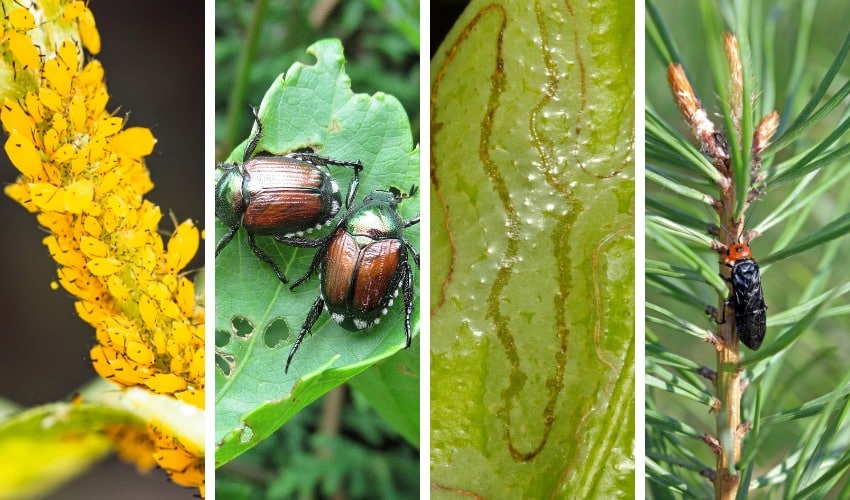
Four of the most common landscape pests in Northeast Ohio: aphids (left), Japanese beetles (center-left), leafminers (center-right), and pine sawflies (right).
What Common Landscape Pests Affect Northeast Ohio Trees?
Beyond destructive threats, a handful of pests show up across Northeast Ohio landscapes year after year. None will kill a mature tree on their own, but they cause real damage — defoliation, disfigurement, sticky honeydew, sooty mold — and are best handled through ongoing plant health care using Integrated Pest Management: targeted, preventive, low-impact treatment that protects beneficial insects while controlling the problem ones.
The most common offenders in Northeast Ohio landscapes:
- Aphids: Sap-feeders that produce sticky honeydew and can attract sooty mold.
- Japanese Beetles: Skeletonize leaves on a wide range of plants starting in late June.
- Boxwood Leafminer: Yellows and disfigures boxwood leaves, common in Northeast Ohio plantings.
- Pine Sawflies: Defoliate pines, especially Mugo pines.
- Summer Pests in General: Covered in our broader guide on how to combat common summer tree pests.
- Ticks and Mosquitoes: Outside the tree category but a major concern across Northeast Ohio yards. We offer all-natural tick and mosquito control programs, and our blog on disease-carrying ticks in NE Ohio explains why this matters.
One pattern shared by every pest in this list: cold winters don’t reliably knock them back. The winter survival biology of NE Ohio insect pests explains why a brutal winter rarely produces the bug-free spring most homeowners hope for.
When Do Tree Diseases and Pests Appear in Northeast Ohio?
Tree diseases and pests in Northeast Ohio appear in different seasons depending on the species — and treatment windows shift by a few weeks every year based on weather. That’s why arborists track Growing Degree Days rather than working off a fixed schedule. Treating too early or too late is often worse than not treating at all.
Spring (March–May)
Spring is when most tree treatment windows open and close quickly — and when wet, cool weather drives the fungal pressure behind most common spring tree diseases in Northeast Ohio. The most important treatment windows:
- Mid-March to Mid-April: Dormant oil window for overwintering pests on evergreens.
- April–May: Apple scab, anthracnose, and fire blight bloom infection window — preventive fungicide applications start here.
- April–July: Oak wilt risk window (do not prune oaks).
- Late April to Mid-June: EAB treatment window for ash trees.
Summer (June–August)
Summer is when many of the diseases that started in spring become visible, and when the warm-season pests show up:
- Late June Onward: Japanese beetles emerge and skeletonize leaves.
- Hot, Dry Weeks: Spider mites peak.
- Mid-to-Late Summer: Tar spot becomes visible on maples (it developed earlier; you’re just now seeing it).
- Throughout Summer: Boxwood leafminer adults become active.
Late Summer–Fall (August–November)
Late summer and fall mark the most visible window for some diseases and the prevention window for next year’s fungal pressure:
- August–November: Beech leaf disease symptoms most visible.
- Late Fall: Fungicide treatments for fire blight on apples, pears, and crabapples.
- Throughout Fall: Leaf cleanup — the highest-leverage prevention for next year’s fungal diseases.
- Full Dormancy Only: Safe window to prune elms.
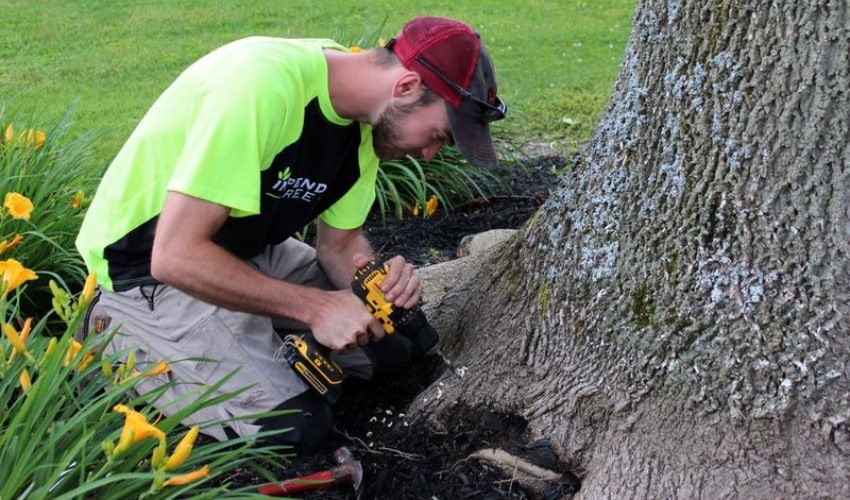
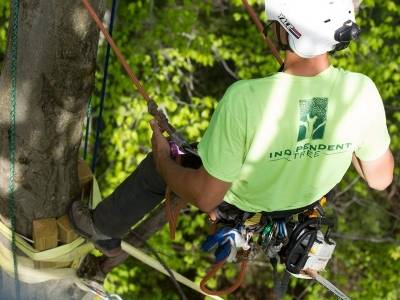
An Independent Tree plant health care technician administering a trunk injection — one of several treatment options for diseases like emerald ash borer, oak wilt, and beech leaf disease.
Frequently Asked Questions About Tree Diseases & Pests in Northeast Ohio
Are tree diseases contagious to humans or pets?
Tree diseases caused by fungi, bacteria, and nematodes are species-specific and don’t transmit to humans or pets. The exception is indirect: equine atypical myopathy has been associated with horses ingesting tar-spot-infected maple leaves. The bigger health concern in your yard though is ticks and mosquitoes, not tree pathogens.
If my neighbor’s tree is diseased, can it spread to mine?
Yes — and this is one of the most common ways diseases spread in Northeast Ohio neighborhoods. Spores travel on wind and rain (tar spot, apple scab, fire blight), beetles fly between yards (oak wilt, EAB, Dutch elm), and tree roots from neighboring properties can graft together underground, transmitting vascular wilts directly. Community-scale prevention often matters more than single-property treatment.
Should I plant disease-resistant trees instead of treating problems?
For new plantings, yes — resistant cultivars are almost always the right call. Crabapple cultivars resistant to apple scab, elm cultivars resistant to Dutch elm disease, and beech alternatives until BLD-resistant cultivars are available all reduce long-term care costs. For established trees, ongoing plant health care is the practical path.
Are there native NE Ohio trees that don’t get any of these problems?
No tree is completely problem-free, but some native species have notably fewer issues than the common imports. American hornbeam, hop hornbeam, native serviceberry, native witch-hazel, and pawpaw all have lighter pest and disease pressure than non-native maples, ornamental pears, and crabapples. Diversity also helps — a yard with five different species is more resilient than one with five of the same.
Schedule a Tree Health Inspection with Independent Tree
The cheapest moment to address most tree problems is before symptoms become severe — which is also the moment most homeowners aren’t looking. A complimentary tree health inspection from one of our ISA Certified Arborists gives you a clear picture of what’s happening on your property: what’s cosmetic, what’s manageable, what’s urgent, and what’s already too late.
Independent Tree has been serving Eastern Cuyahoga, Geauga, Portage, and Lake counties from Newbury, OH since 1995. Call 440-564-1374 or request an estimate online.
Don't wait for problems to become emergencies
The cheapest moment to address a tree problem is before symptoms become severe — which is also the moment most homeowners aren't looking. A free tree health inspection from one of our ISA Certified Arborists gives you a clear picture of what's happening on your property: what's cosmetic, what's manageable, what's urgent, and what's already too late.Recent Articles
Topics
About The Author


STAY IN THE LOOP
WITH OUR
LATEST UPDATES
"*" indicates required fields

