
Galls are abnormal growths on trees and shrubs, usually caused by insects or mites, and in most cases they are harmless. They may look alarming — lumpy, discolored, and sometimes covering entire leaves — but galls rarely threaten the overall health of a tree and often resolve on their own.
What are Galls?
Galls are growths on plants, stems, shrubs, and trees that are most often caused by insects. They have been described as ball-shaped, round, or similar to a lump or a wart. They appear in a variety of colors, including black, green, yellow, or even red.
Galls are essentially a home for insects, providing shelter as the insects grow and reproduce.
Insects that create galls include:
- Mites
- Aphids
- Midges
- Wasps
- And other insects
Some galls can also be produced by viruses, bacteria, fungi, nematodes, and mites.
Insect galls are different than cankers or burls and are not a type of fungi. Galls are created by the growth of plant tissue, while cankers are caused by the death of plant tissue.
Fun fact about galls: Gall ink, a mixture of iron and gallic acid extracted from oak galls, was used for centuries and was the ink used in documents such as the Dead Sea scrolls, Leonardo da Vinci’s notes, Van Gogh’s sketches, the Declaration of Independence, and more!
What Galls Are Common in Ohio?
Galls can grow on many types of trees and plants, but below are some of the trees that you might be likely to notice are gall growths here in Ohio.
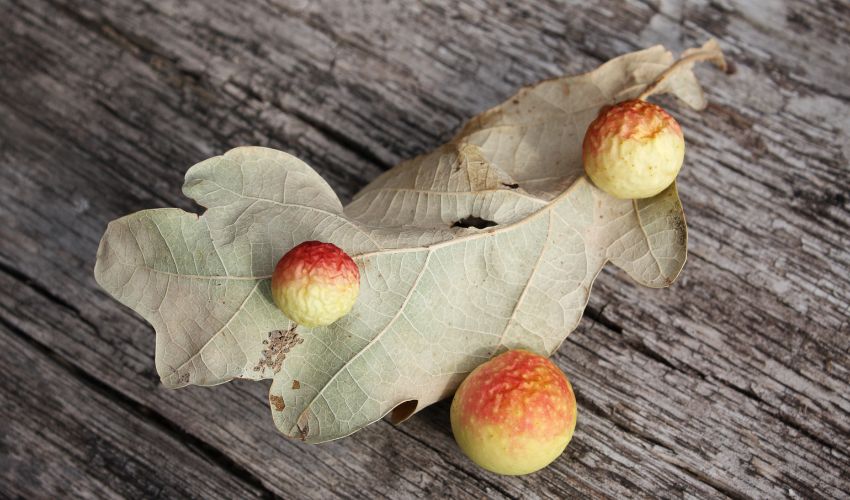
Oak Tree Galls
Oaks are one of the trees most susceptible to galls, as they are known to provide shelter to over 800 types of wasps and other insects.
In Northeast Ohio's Geauga and eastern Cuyahoga counties, we see oak apple galls and horned oak galls most frequently on the red oaks and pin oaks that are so common on residential properties throughout the area.
Oak Apple Galls
Named because of how much they resemble apples, oak apple galls are a common sight on oaks in Ohio. Oak apple galls are formed by a gall wasp and can reach up to 2 inches in diameter.
See photos of oak apple galls >>
Horned Oak Galls
Found on the stems of pin and willow oak trees, horned oak galls can reach 2 inches in diameter that, appear wooden, and can cause branches to girdle and sometimes die back.
Both horned and gouty oak galls can cause injury to oaks, though they rarely lead to a tree’s demise.
Other Oak Galls
Due to the amount and variety of insects that often call oak trees home, there are many potential galls that may appear on oak trees. Some other types of galls include:
- Wood sower gall
- Roly-poly galls
- Crowned oak gal
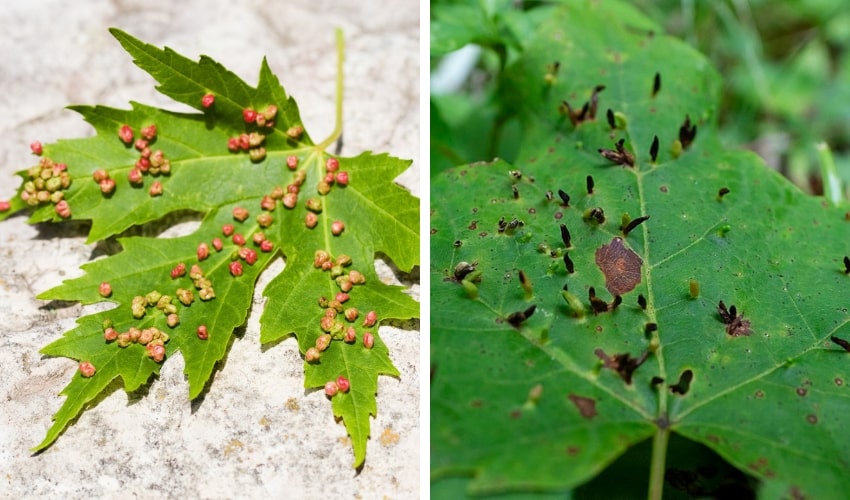
Maple bladder gall and maple spindle gall. Photo on the right of maple spindle gall courtesy of Alex Goodfriend - https://www.inaturalist.org/photos/23191337, CC BY 4.0, https://commons.wikimedia.org/w/index.php?curid=97788172
Maple Tree Galls
Maple tree galls are most often spotted on the foliage of maple trees.
Maple Bladder Gall
Maple bladder galls appear as small red bumps on maple leaves that turn green and then black. Though it looks alarming, maple bladder galls cannot truly damage the tree. The galls are, however, part of the leaf and cannot be removed. There may be some disfigured or wilted leaves from the maple bladder gall.
Dormant oil applications can help to prevent this type of gall as the mites that cause the gall to spend the winter months in cracks in the tree’s bark.
Maple spindle gall
Silver maple trees are more likely to have a leaf gall called maple spindle gall. This gall is not round but instead looks like small worms emerging from the leaf.
Other Maple Tree Galls
Maple trees may also be impacted by maple velvet erineum gall or gouty vein gall.
Galls of maple trees in Ohio >>
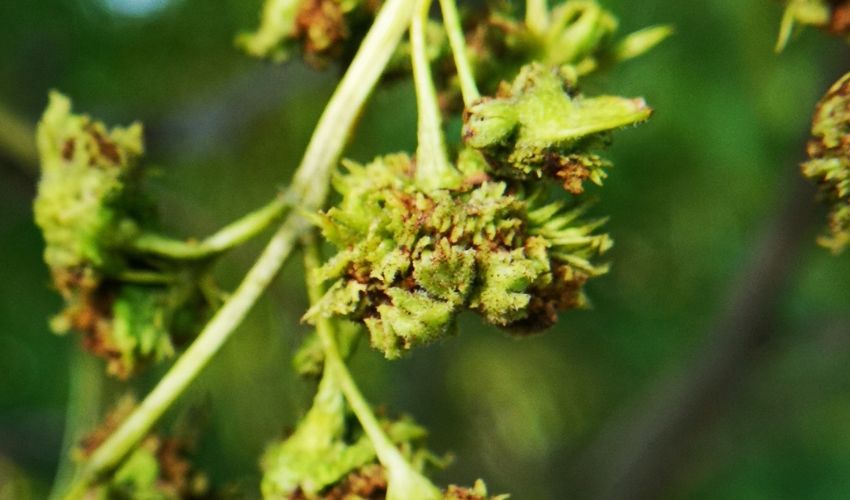
Photo of ash flower gall courtesy of By Alexis Williams - https://www.inaturalist.org/photos/50483449, CC BY 4.0, https://commons.wikimedia.org/w/index.php?curid=97789498
Ash Flower Gall
Ash trees are getting a lot of attention these days due to the Emerald Ash Borer (EAB), but ash trees can also be susceptible to insect galls.
These cluster-like galls are caused by mites and are sometimes called “broccoli” galls due to their unique shape. They are called flower galls because they only impact the tree’s flowers.
See photos of ash flower galls >>
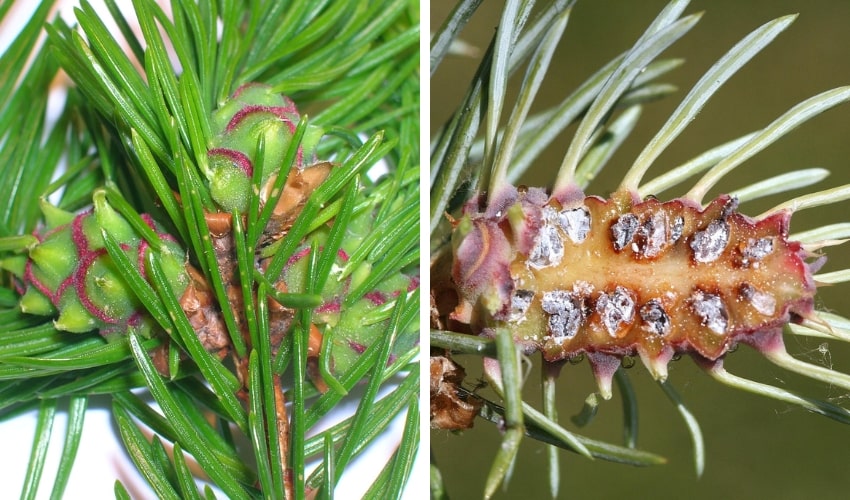
On the left, Eastern spruce gall. On the right, cooley spruce gall. Photo on the right of cooley spruce gall adelgids courtesy of Whitney Cranshaw, Colorado State University / © Bugwood.org, CC BY 3.0 us, https://commons.wikimedia.org/w/index.php?curid=10393516
Cooley and Eastern Spruce Galls
Deciduous trees aren’t the only trees that can be impacted by galls.
Eastern Spruce Gall
Eastern spruce gall is caused by the Eastern spruce gall adelgid, an insect similar to an aphid. Various types of spruce trees are impacted by this adelgid, which produces galls that are shaped like tiny pineapples.
Some dormant oil sprays and insecticide sprays have proven effective against this tree pest.
Cooley Spruce Gall
Cooley spruce gall is also caused by a type of adelgid and impacts Colorado blue, Sitka, and Engelmann spruce trees as well as Douglas-fir trees. It can grow 1 to 2 inches long and resembles a cone or a small pineapple.
Cooley spruce gall adelgids need both a spruce and a Douglas-fir tree to complete their life cycle.
What Should You Do if you Spot Galls?
Thankfully, galls are usually a cosmetic issue more than a plant health concern. Though they often look concerning and look as though some strange disease is taking over your tree or plant, galls are just one more example of plants and insects coexisting in unique ways.
Option One: Ignore The Galls
In most cases, galls will not harm the overall health of your tree. Once the galls have appeared, pesticide treatments will have little impact as the pests are protected inside of the gall.
It is also difficult to reach the galls that are high in tree canopies with insecticides, so the product has very little chance of reaching the insects inside of the galls. Insecticides may also harm the beneficial insects that rely on the insects inside of the galls as a food source.
Because galls are so prominent on trees, they are easily found by natural predators. As long as you encourage these beneficial insects or natural enemies on your property, all you need is a little patience.
Also, there are times when galls are more prevalent and times when they are scarce. This can be due to weather fluctuations, the time of year, the number of natural predators in the area, and more.
While galls may be a cosmetic issue for your tree, one of the best options is to leave them be.
Option Two: Schedule Preventive Dormant Oil Treatments
Dormant or horticultural oils can be applied in early spring before an infestation occurs. Dormant oils can prevent insects that cause galls, such as mites and aphids, from hatching.
If your tree or shrub is susceptible to galls, dormant oils are a great preventative tool. Young trees, especially, should be protected from galls to prevent severe damage.
Learn more about horticultural and dormant oils >>
Option Three: Prune out impacted Areas
We rarely recommend this option because extensive pruning will do more harm to your tree than the galls themselves.
Also, galls not only contain insect pests but sometimes the natural predators that eat those insect pests. If you prune out or remove all galls, you are removing the natural enemies as well.
If you do choose to prune out galls to enhance the cosmetic value of your tree, make sure the pruning cuts are done properly, and consider leaving a few of the galls so that the natural predators also remain.
Want to learn more about galls? The Ohio State University Extension has a series of articles about galls on its website.
When Should You Call an Arborist About Galls?
Most galls don't require treatment. Use this quick triage to decide:
You can safely ignore the galls if:
- The galls are on leaves only (maple bladder gall, oak apple gall) and the tree looks otherwise healthy.
- The galls appeared recently and the tree has normal foliage and growth elsewhere.
- The affected tree is mature and well-established.
Call a Certified Arborist if:
- Galls are on branches or stems (not just leaves), especially horned or gouty oak galls — these can girdle branches and cause dieback.
- A young or recently planted tree has heavy gall coverage that's distorting its growth.
- You're seeing galls alongside other symptoms like crown dieback, bark splitting, or premature leaf drop — the galls may not be the primary issue.
Not sure what you're looking at? Contact us to schedule a tree inspection or call 440-367-8807 and describe what you're seeing — our arborists can help identify the issue.
Contact Independent Tree to Schedule Plant Health Care
Preventive care is the best option if you want to prevent galls from appearing on your trees. Contact Independent Tree to schedule dormant oil treatment, a tree health inspection, or other services to help keep your trees and landscape healthy and thriving.
Not Sure What's Wrong With Your Tree?
If you notice galls or any other issues with your trees' health, contact Independent Tree to schedule a tree inspection.Recent Articles
Topics
About The Author


STAY IN THE LOOP
WITH OUR
LATEST UPDATES
"*" indicates required fields

